


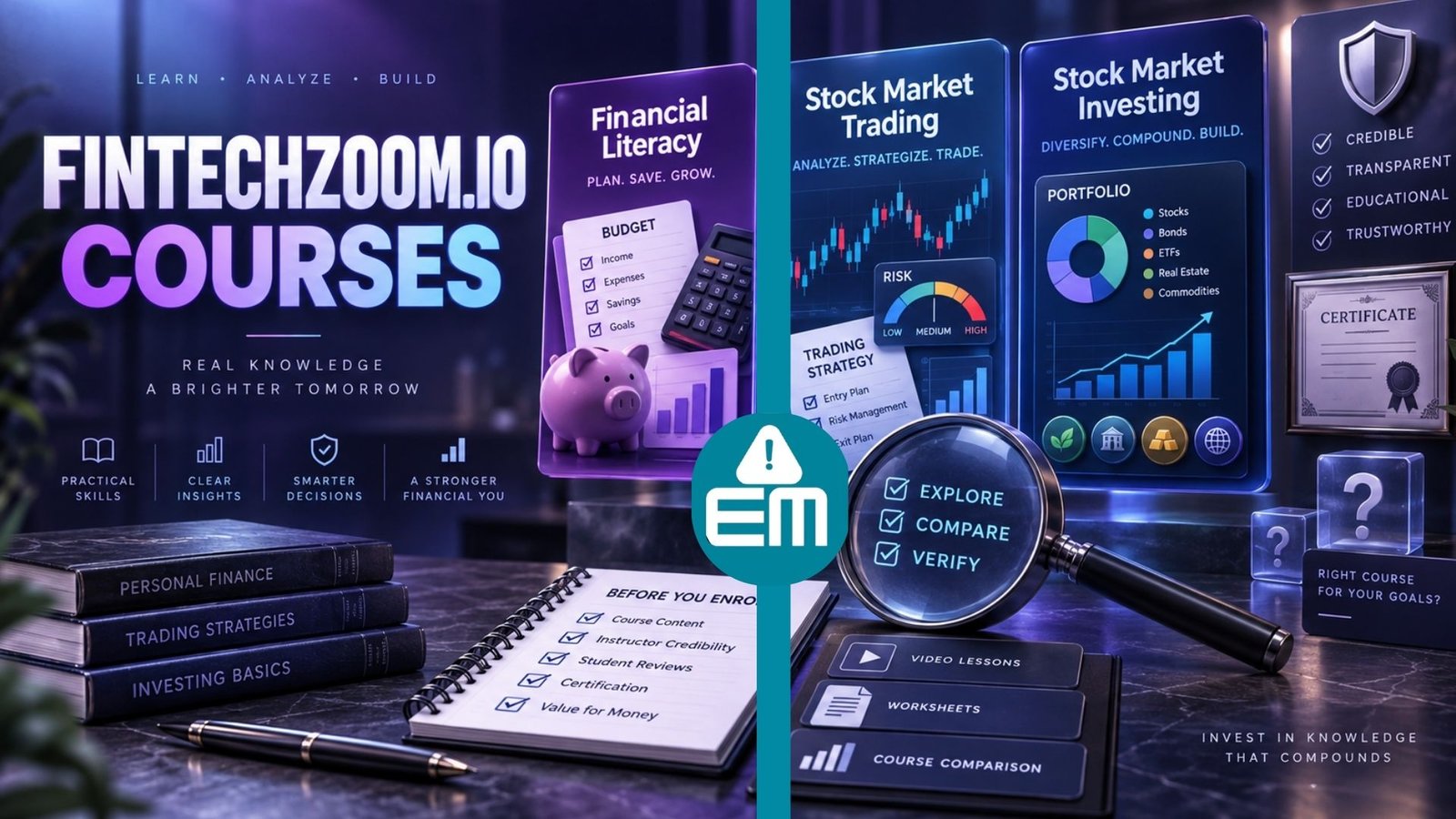

FintechZoom.io courses cover three broad areas: financial literacy, stock market trading, and long-term investing. The public course pages describe self-paced video lessons, downloadable materials, quizzes, support, and completion certificates.
However, important purchasing details are not clearly displayed. The reviewed pages do not identify individual instructors, show course prices, provide detailed module previews, or explain whether the certificates carry external recognition.
That does not automatically make the courses unsuitable. It means prospective students should verify the missing details before registering or paying.
This review reflects publicly accessible information checked in September 2026.
The Three-Course Map
The following comparison summarizes what each course page advertises.
| Course | Main Focus | Advertised Video Length | Suitable Starting Point |
|---|---|---|---|
| Financial Literacy | Budgeting, debt, saving, credit, taxes and basic investing | 3–5 hours | Beginners managing personal finances |
| Stock Market Trading | Charts, trading styles, market indicators and risk controls | 4–6 hours | New or intermediate active traders |
| Stock Market Investing | Asset classes, portfolio building and long-term strategies | 7–8 hours | Beginner and intermediate investors |
All three appear to be self-paced rather than live cohort programs.
The main course directory also advertises lifetime access, interactive exercises, learner support, and a 30-day satisfaction guarantee. These are the platform’s own stated terms, so students should request written confirmation before purchasing.
Choose by the Decision You Need to Make
The easiest way to compare FintechZoom.io courses is not by their titles. Start with the financial decision you are trying to improve.
Choose Financial Literacy for Everyday Money Management
The financial literacy course has the broadest beginner focus. Its advertised subjects include:
- Tracking income and expenses
- Creating a workable budget
- Building an emergency fund
- Managing credit scores
- Reducing debt
- Automating savings
- Understanding interest rates
- Beginning retirement planning
- Avoiding lifestyle inflation
- Learning basic investment principles
The course page also mentions student loans, taxes, credit cards, side income, and budgeting applications.
This option appears most relevant for students, new investors, and working professionals who need a financial foundation before selecting investments.
One limitation is jurisdiction. Tax rules, credit systems, retirement products, and student-loan structures vary by country. International learners should ask which country’s financial system the lessons use.
Choose Stock Market Investing for Long-Term Portfolio Skills
The investing course focuses on selecting and managing assets over longer periods. Its advertised curriculum includes:
- The relationship between risk and return
- Compounding and long-term wealth building
- Stocks, bonds, ETFs and mutual funds
- Real estate and alternative assets
- Asset allocation and diversification
- Value and dividend-growth strategies
- Passive index investing
- Portfolio rebalancing
- International investing
- Economic indicators and market cycles
- Emotional biases in investment decisions
The page also introduces more complex areas, including options, futures, hedging, algorithmic trading, artificial intelligence, trusts, and estate planning.
That is a wide scope for seven to eight hours of video. A prospective student should therefore ask how deeply each subject is covered. Some may be short introductions rather than skills-based modules.
This course appears better suited to someone asking, “How do I construct and maintain a portfolio?” It is less suitable for anyone expecting personalized security recommendations or regulated financial advice.
Choose Stock Market Trading for Shorter-Term Market Activity
The trading course is aimed at people interested in active market participation. Its advertised topics include:
- Candlestick patterns
- Price trends and technical analysis
- Day, swing and position trading
- Stop-loss techniques
- Portfolio allocation
- Trading psychology
- Market indicators
- Margin trading
- Stocks, options and foreign exchange
- News-driven market movements
- Algorithmic trading basics
The page says learners receive four to six hours of video lessons, strategy guides, charts, quizzes, and a completion certificate.
Active trading carries substantial financial risk. Course participation cannot remove that risk or ensure profitable results. Anyone considering this track should look for detailed teaching on position sizing, drawdowns, transaction costs, leverage, recordkeeping, and loss management.
What the Course Pages Explain Clearly
Several practical elements are stated directly on the platform.
Self-Paced Delivery
FintechZoom.io describes the courses as on-demand programs. This may suit learners who cannot attend fixed classes.
Downloadable Learning Materials
The course pages mention worksheets, charts, strategy guides, or other printable resources. These could be useful if they contain worked exercises rather than general summaries.
Quizzes and Exercises
Interactive quizzes are advertised as a way to reinforce learning. The public pages do not show sample questions or explain how assessments are graded.
Learner Support
The main directory says students can contact the team through email or the course platform. It does not publicly state expected response times specifically for course questions.
Completion Certificates
Each individual course advertises a certificate after completion. No public information was found showing that the certificates are accredited, independently assessed, or recognized by employers or professional bodies.
A completion certificate can document participation. It should not be presented as a professional finance qualification unless the issuing organization provides evidence of such recognition.
The Information Still Missing
The public pages provide topic lists, but they do not offer a complete buying picture.
| Information | Publicly Visible Status |
|---|---|
| Three course categories | Clearly listed |
| Approximate video duration | Listed |
| Quizzes and downloadable resources | Advertised |
| Lifetime access | Advertised on the main directory |
| 30-day refund promise | Advertised on the main directory |
| Course price | Not displayed on reviewed pages |
| Named instructors | Not identified on reviewed course pages |
| Instructor credentials | Not provided in a verifiable course profile |
| Complete module-by-module syllabus | Not displayed |
| Sample lesson | Not located |
| Certificate accreditation | Not stated |
| Assessment and passing rules | Not explained |
| Refund exclusions and procedure | Not detailed |
| Course update history | Not shown |
| Student outcome evidence | Not shown |
The enrollment buttons reviewed led toward the general contact route rather than a transparent public checkout containing price and contractual details.
There are also signs that some page descriptions may use generalized course copy. For example, the trading syllabus contains a credit-score lesson, while the investing page describes worksheets for budgeting. These subjects are not necessarily useless, but their placement makes it important to request the actual lesson outline.
Ten Questions to Ask Before Enrolling
Send the provider a short written request covering these points:
- What is the total price, including any taxes or recurring charges?
- Who teaches the course?
- What finance, investing, or teaching credentials does the instructor hold?
- Can I review the complete module list?
- Is a sample lesson available?
- How long does course access remain active?
- What exactly does the 30-day refund policy cover?
- Are there conditions that can prevent a refund?
- Is the certificate accredited or only a completion certificate?
- When were the videos and downloadable materials last updated?
For trading or investing courses, also ask whether demonstrations use real money, paper trading, historical examples, or hypothetical portfolios.
Keep the provider’s answers, payment terms, and refund conditions in writing.
A Note About the FintechZoom Name
Readers should pay close attention to the domain they are visiting. This article evaluates course information displayed on fintechzoom.io.
Some text on the .io website also refers to FintechZoom.com. The reviewed pages do not clearly explain the legal or organizational relationship between every similarly branded domain.
Before paying, confirm:
- The exact company receiving payment
- The website delivering the lessons
- The support email used after enrollment
- The applicable refund terms
- The country governing the transaction
- Whether any similarly named platform is a separate business
Domain similarity should never be treated as proof that two websites share the same ownership or customer protections.
How to Assess the Course After Getting Access
Do not judge a financial course by production quality alone. Test whether it changes your decision-making process.
A useful course should help you produce something concrete. Depending on the subject, that might include:
- A realistic monthly budget
- A debt-repayment schedule
- An emergency-fund target
- A written investment policy
- A diversified sample portfolio
- A trading plan with strict risk limits
- A journal for recording decisions and mistakes
Good financial education should also distinguish facts from forecasts. It should explain uncertainty, fees, taxes, losses, and conflicts of interest—not only potential returns.
Be cautious if lessons promise easy profits, reliable market predictions, guaranteed returns, or financial independence within a fixed period. Markets do not offer guaranteed outcomes.
Final Assessment
FintechZoom.io presents three finance-related course options with clear high-level themes. The financial literacy course covers everyday money management. The investing course addresses portfolio construction and long-term strategies. The trading course focuses on active market analysis and execution.
The advertised flexibility, worksheets, quizzes, and lifetime access may appeal to independent learners. Nevertheless, the public information is not detailed enough to evaluate teaching quality, instructor expertise, certificate value, or overall value for money.
The sensible approach is to treat the available pages as course introductions—not as complete enrollment documentation. Request the price, syllabus, instructor identity, sample material, refund conditions, and certificate status before committing funds.
Your next good read is just a click away: WallPostMedia.com Explained: What the Site Publishes and How to Read It