


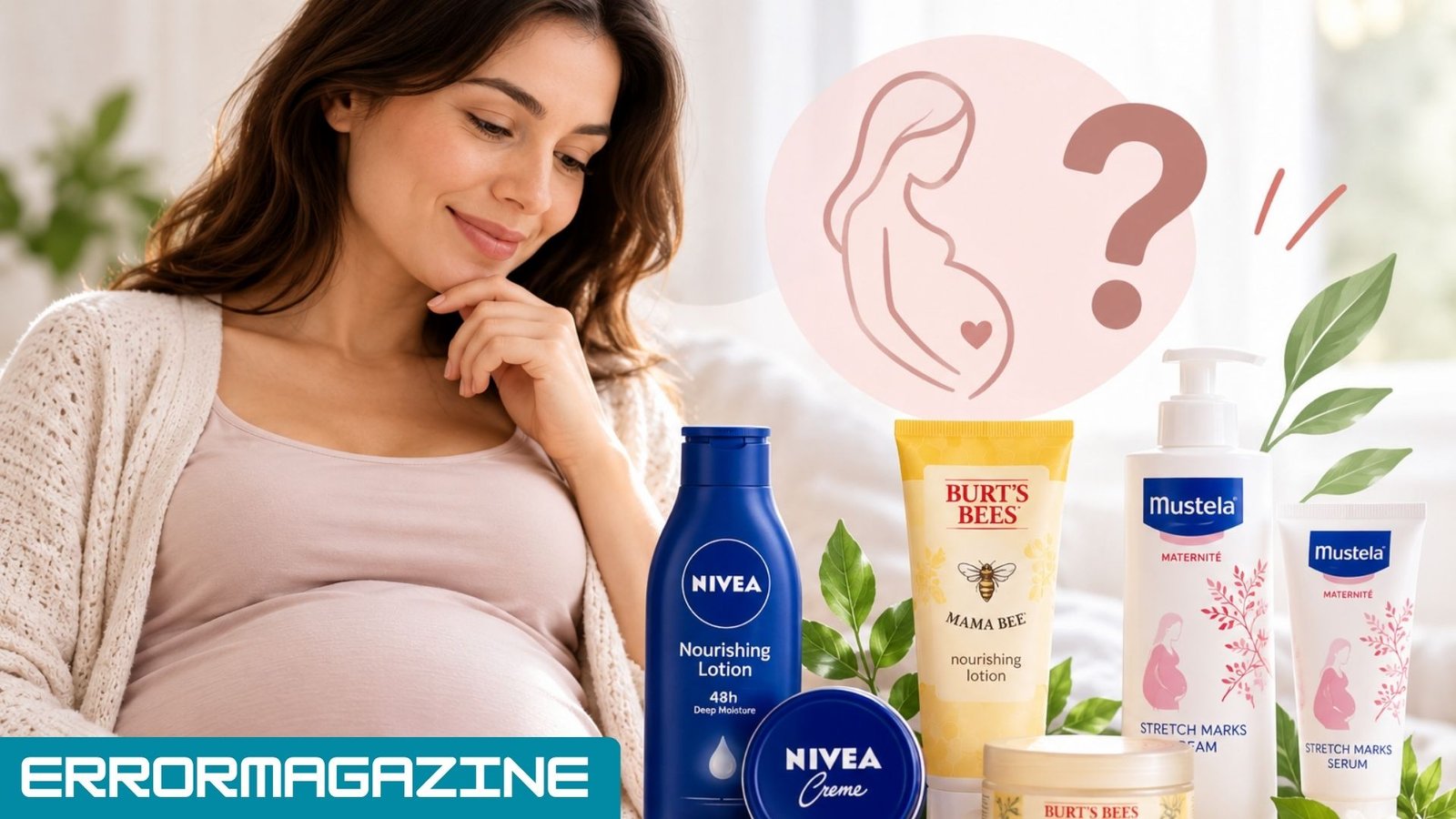

If you are pregnant and already use NIVEA, you generally do not need to replace every NIVEA product simply because Burt’s Bees or Mustela appears more pregnancy-focused.
Most ordinary cosmetic moisturizers and cleansers can be used during pregnancy. NIVEA also states that its cosmetic products are safety-assessed and considered suitable for pregnant and breastfeeding women. However, pregnancy safety is best assessed product by product and ingredient by ingredient, rather than assuming every item from one brand is automatically better than every item from another.
Mustela has a clearer advantage if you specifically want products developed and marketed for maternity care. Burt’s Bees also offers products aimed at mothers. That does not automatically make either brand medically safer than an appropriate NIVEA moisturizer.
The simplest approach is to check what is actually inside the product.
NIVEA vs. Burt’s Bees vs. Mustela During Pregnancy
Here is the practical comparison.
| Brand | Pregnancy perspective | What to remember |
|---|---|---|
| NIVEA | Many standard cosmetics may be suitable during pregnancy | Check each formula, particularly treatment and anti-aging products |
| Burt’s Bees | Offers Mama Bee products intended for pregnancy and postpartum care | “Natural” ingredients do not automatically mean safer |
| Mustela | Has a dedicated maternity range designed for pregnancy and postpartum use | Still check the exact formula if you have allergies or specific medical concerns |
NIVEA says its cosmetic products undergo safety and skin-compatibility evaluation and that its cosmetics are considered safe for pregnant and breastfeeding women.
Mustela goes further with its maternity range. The company specifically markets products such as stretch-mark cream, oil, serum, and maternity lotion for use during pregnancy and postpartum.
Burt’s Bees also has a Mama Bee line designed around pregnancy and motherhood.
Therefore, the biggest difference is often product positioning and formulation, rather than evidence that ordinary NIVEA skincare is inherently unsafe.
Ingredients Matter More Than the Brand Name
This is the most important point.
You cannot reliably decide whether skincare is appropriate during pregnancy simply by reading the brand name on the front.
NIVEA, Burt’s Bees, and Mustela all sell multiple products. Formulas can also differ by product, market, and over time.
Instead, turn the package around and read the ingredient list.
A basic moisturizer containing common moisturizing ingredients is very different from an anti-aging treatment containing a retinoid. Likewise, an ordinary cleanser should not be treated the same way as a strong acne treatment.
Pregnancy is also a good time to simplify your skincare routine.
A gentle cleanser, moisturizer, and appropriate sunscreen may be enough for many people.
Which Skincare Ingredients Should Pregnant Women Avoid?
Retinoids and Retinol
Retinoids deserve the most attention.
Oral isotretinoin is known to cause serious birth defects and must not be used during pregnancy. Topical retinoids have much lower systemic absorption, but medical authorities generally recommend avoiding them during pregnancy as a precaution.
Look for names such as:
- Retinol
- Retinal or retinaldehyde
- Tretinoin
- Adapalene
- Tazarotene
- Other retinoid medications
If your NIVEA, Burt’s Bees, Mustela, or another skincare product contains a retinoid, discuss it with your obstetrician or dermatologist rather than assuming it is acceptable because it is sold over the counter.
Hydroquinone
Hydroquinone is used to lighten areas of hyperpigmentation.
The American Academy of Dermatology recommends avoiding hydroquinone during pregnancy. This becomes particularly relevant because pregnancy itself can cause melasma and other pigmentation changes.
Instead of treating pregnancy-related pigmentation aggressively on your own, consider asking a dermatologist about pregnancy-appropriate alternatives.
Salicylic Acid
Salicylic acid requires more nuance.
It is incorrect to say that pregnant women must avoid every topical product containing salicylic acid. The American College of Obstetricians and Gynecologists lists topical salicylic acid among over-the-counter ingredients that can be used during pregnancy.
However, dermatologists advise more caution with high concentrations and extensive use. The American Academy of Dermatology recommends discussing high-dose salicylic acid, particularly concentrations above 2%, with a dermatologist.
That means a small amount in a limited-use skincare product is not equivalent to using a strong peel over a large area.
Read more : Rodolphe Saadé and Greg Hayes: Careers, Leadership and Business Backgrounds
Benzoyl Peroxide
Benzoyl peroxide is another common acne ingredient.
Current medical guidance allows some use during pregnancy, although the American Academy of Dermatology recommends limited use and discussion with a healthcare professional.
If pregnancy has caused significant acne, an obstetrician or dermatologist can help you build a routine rather than relying on trial and error.
What About Ordinary NIVEA Creams and Body Lotions?
A standard moisturizer deserves different consideration from an acne medicine or anti-aging serum.
For example, ordinary body lotions and moisturizing creams primarily intended to reduce dryness do not automatically become unsuitable when you become pregnant.
In fact, pregnancy can make skin feel dry, tight, itchy, or more sensitive. Regular moisturizing can therefore become particularly useful.
NIVEA itself states that its cosmetics are evaluated for safety and considers them suitable for pregnant and breastfeeding consumers.
Still, check the current ingredient list of the exact product you own. Do not rely solely on an old online ingredient list because manufacturers can reformulate products.
If your skin becomes more sensitive during pregnancy, a fragrance-free moisturizer may also be more comfortable.
Is Burt’s Bees Better Because It Is More Natural?
Not necessarily.
“Natural” should not be used as a synonym for “pregnancy-safe.”
Plant extracts, essential oils, fragrances, and other naturally derived substances can still cause irritation or allergic reactions. Meanwhile, many synthetic cosmetic ingredients have well-understood safety profiles when used correctly.
Therefore, choose Burt’s Bees because a particular product suits your needs and has an appropriate ingredient list—not simply because the packaging emphasizes natural ingredients.
The same principle applies to other natural or organic skincare brands.
Does Mustela Have an Advantage During Pregnancy?
Mustela has one practical advantage: it maintains a dedicated maternity range.
Its maternity products include formulas specifically presented for pregnancy and postpartum skincare. For example, Mustela states that its stretch-mark serum can be used during pregnancy and after delivery, while its stretch-mark cream is intended for use beginning during pregnancy.
This can make shopping simpler because maternity use has been considered during product development and marketing.
However, that still does not establish that every Mustela product is superior to every NIVEA or Burt’s Bees product.
If you already tolerate a simple NIVEA moisturizer with an appropriate formula, there may be no pregnancy-related reason to replace it solely because another container says “maternity.”
What About Sunscreen During Pregnancy?
Sun protection becomes especially important because pregnancy can contribute to pigmentation changes such as melasma.
The American Academy of Dermatology recommends broad-spectrum, water-resistant sunscreen with SPF 30 or higher. It specifically suggests physical or mineral sunscreen containing zinc oxide, titanium dioxide, or both during pregnancy.
You can also reduce UV exposure through shade, protective clothing, and hats.
Again, compare actual sunscreen formulas rather than deciding based only on whether the bottle says NIVEA, Mustela, or another brand.
A Simple Pregnancy Skincare Routine
Pregnancy does not require a complicated beauty routine.
For many people, a straightforward routine works well.
Morning: Gently cleanse your face, apply moisturizer if needed, and finish with broad-spectrum SPF 30 or higher.
Evening: Cleanse your skin and apply a simple moisturizer.
If you need treatment for acne, eczema, melasma, severe itching, or another skin condition, discuss the treatment ingredients with your obstetrician or dermatologist.
This approach reduces unnecessary exposure to multiple active ingredients while also making it easier to identify anything that irritates your skin.
What If I Already Used a Product Before Realizing I Was Pregnant?
Do not assume that accidentally using a questionable skincare ingredient means your pregnancy has been harmed.
Exposure depends on the ingredient, concentration, amount applied, area of skin, frequency, duration, and how much enters the bloodstream.
For example, only a relatively small amount of topical tretinoin is generally absorbed through healthy skin. Nevertheless, medical authorities recommend avoiding topical retinoids during pregnancy because safer alternatives are available and uncertainty remains.
If you discover that you have been using a retinoid or another medication that is discouraged during pregnancy, stop using it and contact your healthcare professional for advice specific to your exposure.
FAQs
Can I use NIVEA cream on my belly while pregnant?
An ordinary NIVEA moisturizing cream is not automatically unsafe during pregnancy. NIVEA states that its cosmetic products are considered suitable for pregnant and breastfeeding women. Check the ingredient list of your exact product, particularly if it contains treatment or anti-aging ingredients.
Is Mustela safer than NIVEA during pregnancy?
There is no good basis for declaring the entire Mustela brand safer than the entire NIVEA brand. Mustela does, however, offer a dedicated maternity range specifically formulated and marketed for pregnancy and postpartum skincare.
Is Burt’s Bees automatically safer because its products contain natural ingredients?
No. Natural origin does not automatically equal pregnancy-safe or irritation-free. Evaluate the complete formula and your individual skin needs.
Can I use salicylic acid while pregnant?
Topical salicylic acid is included by ACOG among OTC ingredients that can be used during pregnancy. However, higher concentrations or extensive use deserve more caution, so ask your healthcare professional about strong peels or frequent high-dose use.
Which skincare ingredient should I be most careful about during pregnancy?
Retinoids are among the clearest ingredients to avoid. This includes prescription retinoids and over-the-counter retinol-containing skincare. Hydroquinone should also be avoided according to current dermatology guidance.
Closing Takeaway
For most pregnant women, the choice is not simply NIVEA versus Burt’s Bees versus Mustela.
NIVEA says its cosmetics are considered suitable during pregnancy. Mustela offers a maternity-specific range, while Burt’s Bees offers products specifically positioned for mothers. None of those facts replaces checking the exact formula.
Focus on ingredients rather than marketing terms such as “natural.” Keep your routine simple, avoid retinoids and hydroquinone, be cautious with stronger treatment products, and use appropriate sun protection.
Most importantly, if you want to continue using a particular product during pregnancy, show its current ingredient list to your obstetrician, midwife, pharmacist, or dermatologist. They can consider the exact formula alongside your pregnancy and medical history.
More topic on ErrorMagazine