
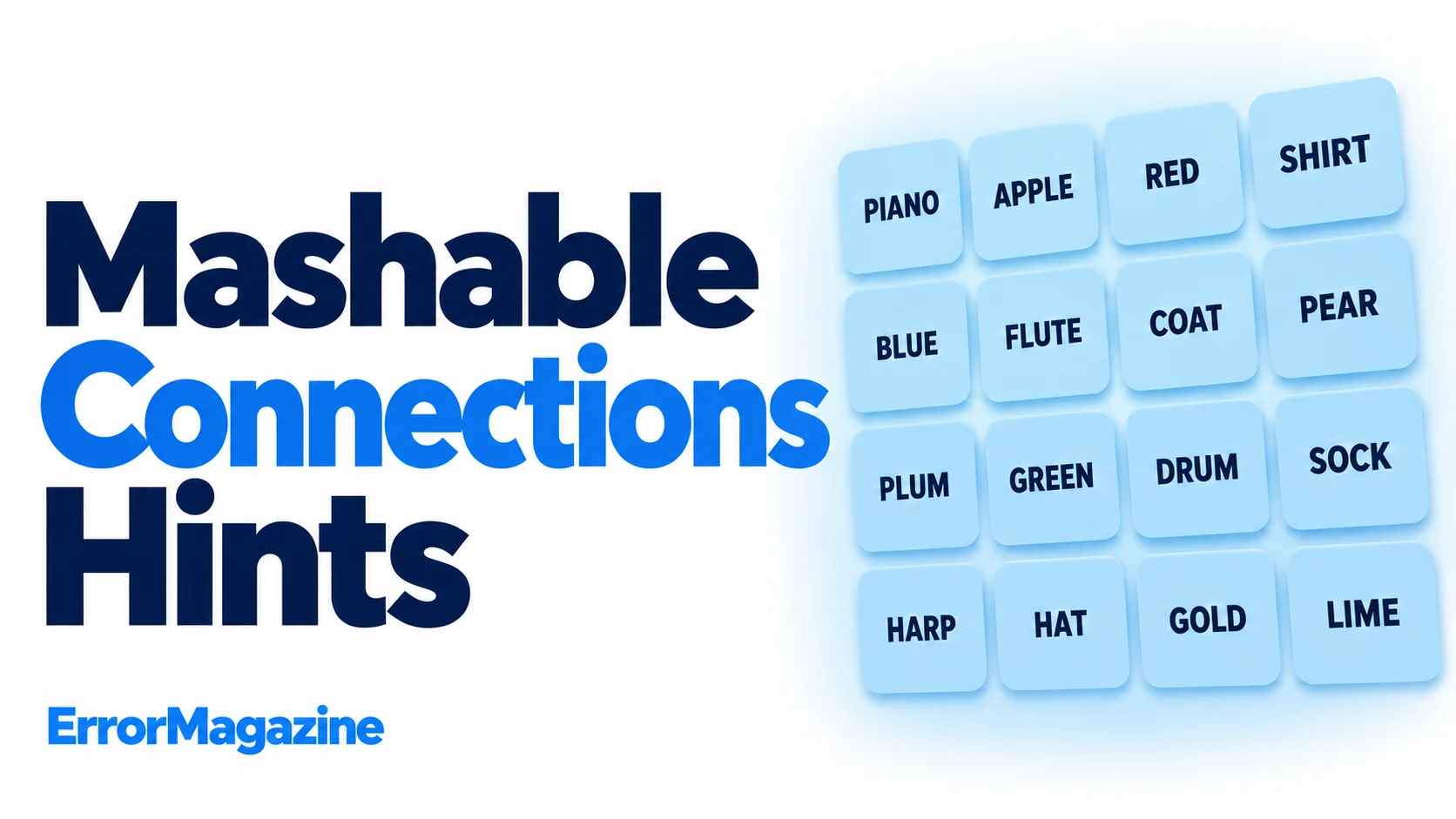

Mashable Connections hints are clues published by Mashable to help readers solve The New York Times’ Connections puzzle. They serve readers who want help identifying the links between words before checking the complete answers. Mashable’s own social posts confirm its coverage of dated Connections puzzles.
To use a daily hint guide effectively, match its date and puzzle number to your game, read only the help you need, and return to the board. This article explains that process and offers practical solving advice. It does not present an unverified set of answers as today’s solution.
What Are Mashable Connections Hints?
The phrase “Mashable Connections hints” refers to Mashable’s coverage of the NYT word game. The distinction matters: The New York Times publishes Connections, while Mashable publishes supporting editorial coverage for people looking for clues or answers.
A reader searching this phrase may want different levels of help. Someone with three groups solved might need a small suggestion. Another player might want the complete solution and an explanation of the remaining category.
Those needs require different amounts of information. A broad clue leaves room for discovery, while a category name reveals the relationship more directly. A full answer gives away the four words themselves.
Before reading further down any puzzle guide, decide which kind of help you want. That simple choice can prevent an accidental spoiler.
Understand the Puzzle Before Reading a Hint
According to The New York Times Help Center, Connections presents 16 words that players must arrange into four groups of four. Each group shares a connection, and the puzzle has one intended solution. Some words can appear to fit several possible categories, which creates much of the challenge.
The four category colors indicate relative difficulty:
| Color | Intended difficulty |
|---|---|
| Yellow | Easiest |
| Green | More challenging than yellow |
| Blue | More challenging than green |
| Purple | Trickiest |
The NYT identifies yellow as the easiest category and purple as the trickiest. However, your own knowledge can make a supposedly difficult relationship easier to spot than a straightforward one.
For that reason, focus on finding a convincing connection rather than trying to predict its color. A group should have a clear explanation that applies consistently to all four words.
How to Find the Right Daily Hint Guide
Match the date and puzzle number
Do not rely on the word “today” alone. A search result, saved bookmark, or shared post may lead to an older article.
Check the date in the headline and compare the puzzle number with your game when both are available. If either differs, avoid reading the answers until you establish which board the article covers.
The NYT says the daily puzzle releases at midnight in your local time zone. Consequently, people in different countries can reach a new puzzle at different moments. This makes an explicit date more useful than an undated reference to “today.
Confirm which game you are playing
Connections and Connections: Sports Edition are distinct puzzles. The NYT Help Center identifies Sports Edition as a version from The Athletic that follows the same basic grouping rules. A guide for one board will not solve the other.
Check the game name before comparing words. If a clue seems completely unrelated to your board, an edition mismatch is worth checking before assuming the clue is wrong.
Use Hints Gradually to Protect the Challenge
A useful approach is to move from the smallest clue toward a complete answer only when necessary.
First, examine the board without outside help. Identify possible relationships and note which words seem ambiguous. You will then have a specific question when you consult a guide.
Next, read a broad clue for the group causing trouble, if the guide offers one. Return to the puzzle immediately and reconsider the remaining words.
If that does not help, a category name may provide enough direction. Save the complete word list for the point when you want an explanation or have decided to stop solving independently.
This is a suggested reading method, rather than a claim that every Mashable article uses an identical layout. Always watch for headings that signal category reveals or complete answers before scrolling.
Practical Ways to Think Through Difficult Groups
Give every word the same test
A possible category should explain all four selections in the same way.
For example, an invented group containing PIANO, ORGAN, SYNTHESIZER, and ACCORDION could share the relationship “instruments with keyboards.” Each word meets a specific test.
By comparison, “things connected with music” would be too broad to justify many possible selections. The narrower explanation helps you evaluate whether the group holds together.
This example illustrates a solving method; it is not presented as an actual NYT puzzle category.
Consider another meaning
A familiar word can hide an unfamiliar role. “Pitch,” for instance, can describe a musical quality, a throw, or a sales presentation.
When a group almost works, reconsider the meanings of its words instead of immediately replacing one. The apparent outlier may fit a different interpretation that connects the whole set.
Also check whether you are mixing relationships. Three synonyms and one loosely associated object may feel related without forming a consistent category.
Test phrases as well as definitions
Some possible relationships involve words that combine with a shared term. Try placing the same word before or after each candidate.
The resulting expressions should all be recognizable and follow the same pattern. If one requires a strained explanation, reconsider the group.
This gives you a concrete way to use a hint suggesting language or wordplay without jumping directly to the answer.
Research Notes: What Was Checked
The research for this guide used The New York Times Help Center to establish the game’s rules, category colors, release schedule, and distinction from Sports Edition. Mashable’s own public social coverage confirmed that it publishes dated Connections hints and answers.
Direct access to Mashable’s article pages was blocked during research. Therefore, this guide does not claim to verify the exact layout of its latest article or reproduce its current clues.
The solving recommendations are editorial analysis based on the grouping task. They are not results from player interviews, a controlled study, or firsthand testing of today’s board.
That distinction matters when assessing puzzle advice. Verified rules explain how the game works; suggested methods help readers approach it. Neither justifies inventing a daily solution or claiming that one strategy always succeeds.
Frequently Asked Questions
Does Mashable publish the Connections game?
The New York Times publishes Connections. Mashable provides editorial coverage, including dated hints and answers for readers seeking help.
Can I use a hint without seeing every answer?
You can limit what you read, but proceed carefully. Check section headings and stop before category names or complete word groups if you want only a small clue.
Why do the hints seem unrelated to my board?
Check the article’s date, puzzle number, and game edition. An older guide or a Sports Edition article may cover a different set of words.
Do Connections hints guarantee a win?
No. A clue can help you reconsider a relationship, but you still need to select the intended groups. A broad hint may also support several interpretations.
Does this article contain today’s Mashable answers?
No. This is a general guide to finding and using hints. Today’s Mashable article and its exact answers were not directly verified during research.
Conclusion
Mashable Connections hints can help readers move past a difficult word group while preserving some of the solving experience. Check the correct puzzle first, choose how much help you want, and test each proposed relationship consistently. The most useful clue gives you enough direction to return to the board with a clearer idea.
NEXT ONE : Fielder Jewett: Biography, Age, Family, Career and Net Worth