
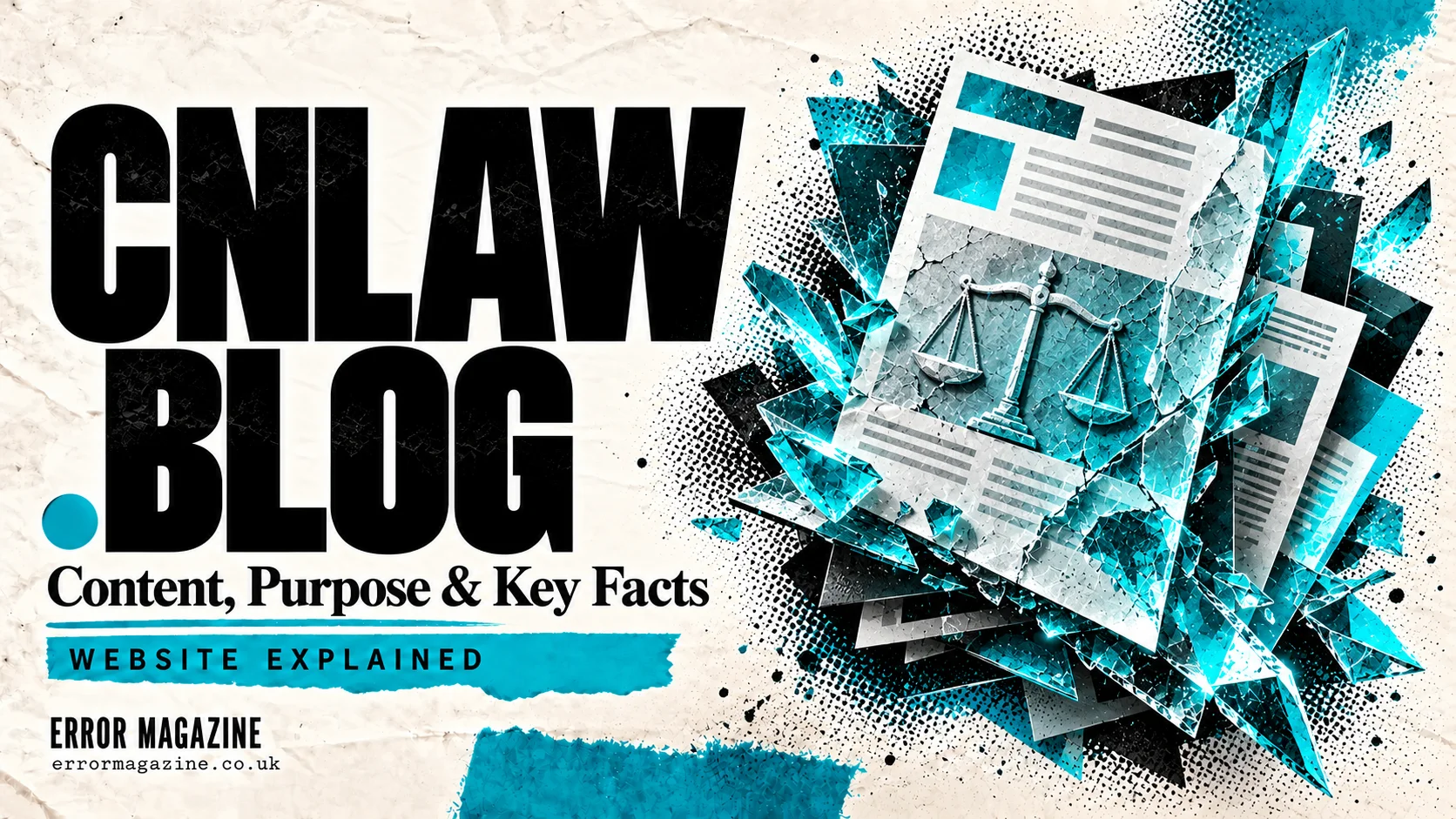

CNLawBlog is a general-interest online publication that covers law alongside technology, business, finance, health, education, and lifestyle. Although its name suggests a legal specialty, its current content extends well beyond legal topics.
Readers looking for the publication can visit CNLawBlog’s website. This independent overview examines its visible content and stated publishing policies. It also explains an important distinction: CNLawBlog.com and the China Law Blog published by Harris Sliwoski are different publications.
What Is CNLawBlog?
CNLawBlog describes itself as an independent online publication that aims to make complex subjects understandable to a broad audience. Its editorial policy identifies a wide range of subjects, including consumer information, home improvement, gaming, and real estate.
The most accurate way to understand the website is as a collection of informational articles across several categories. Its own description does not establish that it is a government resource, an official legal database, or a law firm.
That distinction helps readers set appropriate expectations. Someone searching for an introductory explanation may find relevant material, while someone researching a specific legal problem will need to examine the article’s sources, jurisdiction, and author qualifications.
Read this Thetechyx.com: What It Offers and What Readers Should Know
What Does the Website Cover?
The homepage combines legal subjects with money, technology, and everyday topics. During this review, visible article listings included insurance claims, personal injury, online borrowing, artificial intelligence, gaming, and screen time.
This variety shows why the website should not be described solely as a Chinese business-law resource. Its published subject mix is considerably broader.
Legal information
The website organizes legal content into categories such as civil, corporate, criminal, family, accident, and personal injury law.
These labels help readers browse, but a category name alone does not establish the legal authority of an article. Readers still need to check whether the writer identifies the relevant location, explains important exceptions, and supports legal statements with appropriate references.
Technology articles
One accessible example was an article titled “The Future of Edge AI and Data Sovereignty,” carrying a Jamie byline and a July 7, 2026 date.
Its opening sections discuss running artificial intelligence on local devices rather than relying entirely on remote cloud servers. This provides a concrete example of the site’s technology coverage beyond legal publishing.
However, the presence of a technical explanation does not by itself establish that its author performed hands-on testing or has specialist qualifications. Those are separate claims that require evidence.
Is CNLawBlog the Same as China Law Blog?
No. CNLawBlog.com should be distinguished from the China Law Blog hosted on Harris Sliwoski’s website.
The Harris Sliwoski publication sits within the law firm’s website and publishes China-related business and legal analysis. Its accessible article listings included distribution agreements, manufacturing, intellectual property, and international disputes.
CNLawBlog.com, by comparison, presents a broader mix of general information. The similar names do not establish shared ownership, authorship, or affiliation.
There are also similarly named domains. For example, cnlawblogs.com—with an additional “s”—presents Chinese-law guides and advertises legal tools on its homepage. Those features should not automatically be attributed to cnlawblog.com.
When searching for a particular article or publisher, check the complete web address before assuming that two results belong to the same organization.
What Does Its Editorial Policy Say?
CNLawBlog’s editorial policy describes a process involving topic selection, research, writing, review, and publication. It also says that articles may be revised when information changes or errors are identified.
The policy discusses using publicly available sources, distinguishing opinion from fact, identifying sponsored material where applicable, and accepting reader feedback.
It further states that digital tools may assist parts of the publishing process and that articles receive human review before publication. These are the publisher’s stated practices. Reading the policy does not independently confirm how the process was applied to every article.
For readers, the practical next step is to look for evidence within the article itself: identifiable references, clear attribution, relevant author information, and corrections when necessary.
Can Readers Use It for Legal Advice?
CNLawBlog’s disclaimer says its content serves general informational and educational purposes. It explicitly states that legal articles do not constitute legal advice or representation.
The disclaimer also says that using the website does not create a professional or client relationship. Similar limitations apply to its financial, medical, tax, and other professional subjects.
An introductory article can help a reader understand terminology or prepare questions. Applying that information to a particular dispute, contract, or financial decision requires additional verification.
How to Evaluate an Article Before Relying on It
Evaluate the specific page rather than assuming that every article on a publication has the same strengths.
Useful checks include:
- Scope: Does it identify the country, state, product, or situation it addresses?
- Authorship: Does the byline connect to relevant experience or qualifications?
- Evidence: Can you trace important statements to original documents?
- Timing: Does the article describe current rules or an earlier situation?
- Limits: Does it explain exceptions and circumstances that could change the answer?
For technology content, distinguish an overview from a tested tutorial. For legal content, distinguish a general explanation from advice based on someone’s individual circumstances.
These checks provide a more useful assessment than a blanket claim that an entire website is either reliable or unreliable.
Conclusion
CNLawBlog is best understood as a multi-topic informational publication with a legal section. Its visible publishing policies explain its intended standards, while its disclaimer sets limits on how readers should use the material.
The key is to identify the correct domain, distinguish it from similarly named publications, and assess each article through its authorship, evidence, scope, and currency.
Read This : Trupeek com: Website, Content, Ownership, and Public Information