

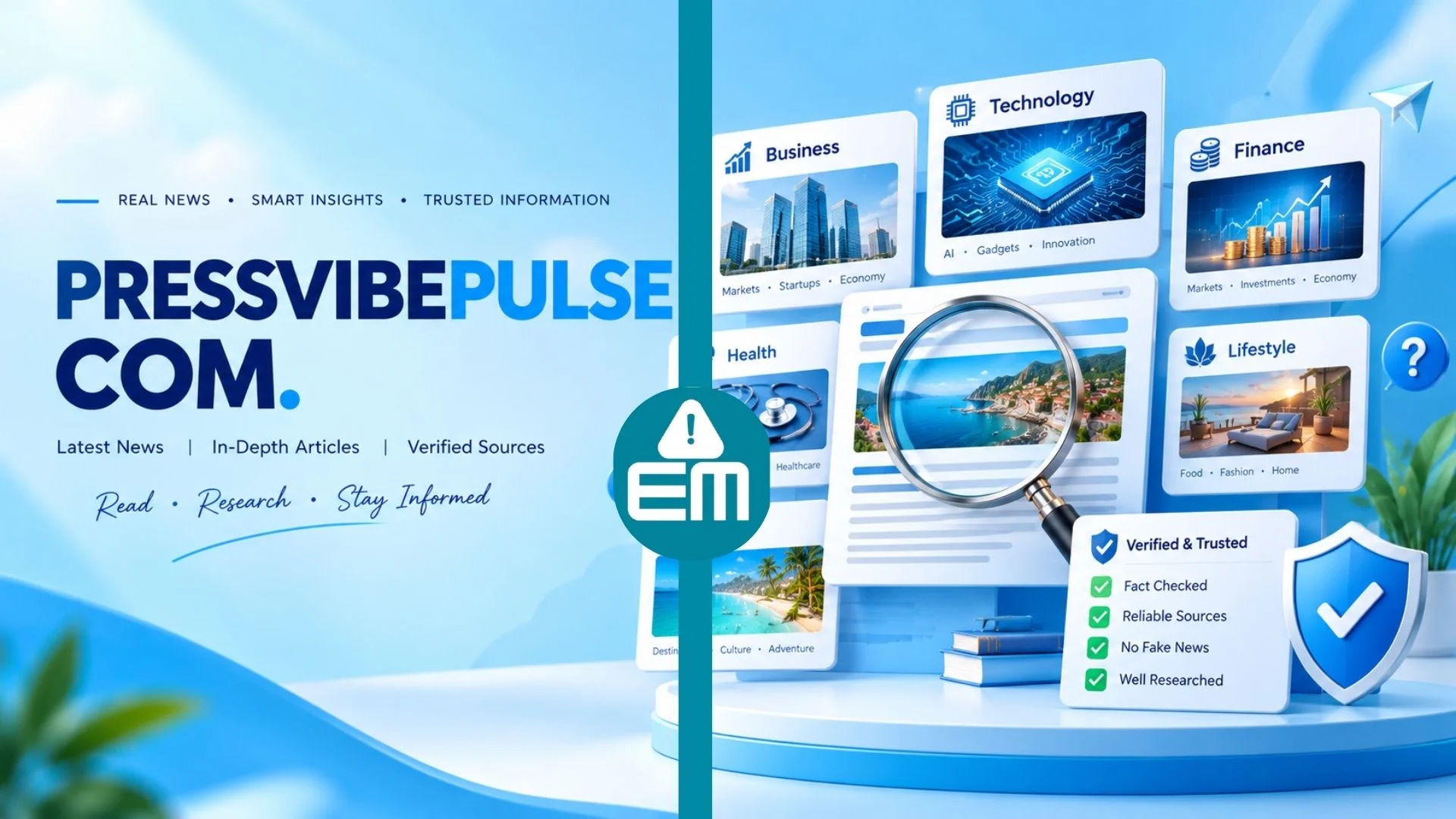

PressVibePulse com is a multi-topic publishing website featuring articles about business, finance, technology, health, lifestyle, fashion, travel, automotive subjects, and general-interest questions. It is best understood as a broad content platform rather than a specialist newspaper, professional journal, or official information service.
The website can help readers discover subjects and get a basic overview of unfamiliar topics. However, its articles should be evaluated individually—especially when they involve money, health, taxes, travel rules, products, or other decisions where outdated or inaccurate information could have consequences.
The Site in One Minute
A review of the website reveals the following characteristics:
| Area | What a Reader Can Observe |
|---|---|
| Publishing model | General-interest, multi-category content website |
| Main subjects | Business, finance, technology, health, lifestyle, fashion and travel |
| Additional material | Automotive topics, nature questions, city guides and practical explainers |
| Article presentation | Headlines, category labels, dates, excerpts and author bylines |
| Reading cost | Public articles were accessible without a visible subscription requirement |
| Suitable use | Topic discovery and introductory reading |
| Important limitation | Authority and accuracy should be assessed article by article |
The range is unusually broad. A reader might encounter an article about mileage tracking for freelance writers, followed by a Seattle travel guide, a discussion of touchless technology, or an explanation of bird symbolism.
That variety makes casual browsing convenient, but it also means the website does not demonstrate the same subject focus across every category.
Reading PressVibePulse Com by Evidence, Not Branding
A polished design or confident writing style does not automatically make a publication authoritative. The more useful question is whether a particular article gives readers enough evidence to trust its claims.
Before relying on an article, look for four things:
- A clearly identified writer: A byline is a starting point, but a detailed author page should explain the writer’s experience or relevant expertise.
- Traceable support: Important factual claims should be connected to government publications, original research, official product documentation, direct reporting, or other primary evidence.
- A meaningful date: Readers should be able to tell when the information was published and whether it has been reviewed since then.
- A functioning correction or contact route: A credible publication should make it reasonably easy to report an error, ask a question, or understand its editorial policies.
During this review, the homepage displayed author names and publication dates. However, several footer pages intended to explain the site—including its About, Privacy, and Contact or copyright information—returned a WordPress critical-error message when opened. This may be a temporary technical problem, but it limits the amount of ownership and editorial information a reader can verify.
What Type of Content Can You Find?
Business and Finance
The business and finance sections contain practical explainers, professional topics, market-related subjects, and articles aimed at freelancers or business readers.
These sections may be useful for identifying questions to research. They should not replace current information from tax agencies, financial regulators, qualified accountants, or other appropriate professionals.
A financial article should specify the country and tax year to which it applies. Advice written for the United States, for example, may be irrelevant or incorrect for someone living elsewhere.
Technology
Technology coverage includes consumer concepts, digital trends, devices, and subjects such as touchless systems. Introductory technology articles can help readers understand terminology before moving to more technical documentation.
For product specifications, software instructions, security issues, or compatibility details, confirm the information with the manufacturer or developer. Technology changes quickly, and an undated or older guide may no longer match the current version of a product.
Health and Lifestyle
Health and lifestyle are broad categories that can range from everyday wellness ideas to claims that require medical evidence.
Readers should distinguish between general lifestyle suggestions and medical guidance. Warning signs include claims of guaranteed results, unsupported treatments, missing sources, or advice that encourages someone to delay professional care.
Travel
Travel material may offer destination inspiration, local overviews, and planning ideas. These articles can be useful at the early research stage.
Before booking or travelling, verify entry requirements, transport schedules, fees, opening times, safety notices, and local regulations through official sources. A travel article can become outdated even when its general description of a destination remains useful.
General-Interest Articles
PressVibePulse com also publishes articles that do not fit neatly into a specialist category. Examples visible during the review included nature symbolism, bird identification, automotive subjects, and city guides.
This type of material is suitable for casual exploration, but readers should still distinguish factual identification from cultural interpretation. A symbolic meaning, for instance, is not the same as a scientifically established fact.
A 60-Second Reliability Check
Readers do not need to conduct a full investigation before opening every article. The following routine can quickly reveal whether a page deserves more confidence.
First: Identify the exact claim
Ask what the article is actually telling you. Is it explaining a concept, recommending a product, reporting an event, or giving instructions?
The greater the consequences of acting on the claim, the stronger the evidence should be.
Second: Inspect the date and jurisdiction
A current date does not guarantee accuracy, but it tells you when the information was presented. For rules, prices, taxes, schedules, and product features, check whether the article identifies the relevant country and period.
Third: Look for original evidence
Search the article for named studies, official documents, direct statements, data sources, or product documentation. General phrases such as “experts say” are weak when no expert or evidence is identified.
Fourth: Check the writer
Open the author profile if one is available. Look for a biography, relevant background, other work, and a way to understand why that person is qualified to cover the subject.
Fifth: Examine outbound links carefully
Confirm where a link leads before following it, particularly when the destination is shortened, unfamiliar, or unrelated to the surrounding text. Do not submit personal details or download a file simply because a link appears inside an article.
Worked Example: Evaluating a Tax Article
Suppose a PressVibePulse com article discusses vehicle-mileage records for freelance workers. Rather than accepting the headline at face value, a reader could evaluate it in the following order:
- Determine which country’s tax system the article addresses.
- Check the tax year because rates and deduction rules can change.
- Separate general record-keeping advice from specific claims about eligibility.
- Confirm figures and requirements with the relevant tax authority.
- Ask a qualified tax professional about unusual or high-value deductions.
The article may still provide a helpful introduction. The verification process simply prevents an introductory guide from being mistaken for personalised tax advice.
The same method works for health, travel, finance, and product-related content.
Transparency Signals That Need Improvement
PressVibePulse com has several visible features associated with a conventional publishing website: category navigation, dated articles, bylines, a search function, and footer links for policies.
However, transparency is not measured by the presence of labels alone. Those pages must work and provide meaningful information.
At the time of review, the following points deserved caution:
- Important policy and background pages produced technical errors.
- Publicly visible bylines did not, by themselves, establish subject expertise.
- Some outbound destinations were not clearly explained by their surrounding context.
- The wide subject range makes it necessary to evaluate expertise separately for each article.
None of these observations proves that the entire website is fraudulent. They do mean readers should avoid treating every page as equally authoritative.
Is PressVibePulse Com Legitimate?
There is not enough verified evidence to label PressVibePulse com either a scam or a fully authoritative publication.
The site has an accessible homepage, visible articles, navigation categories, dates, and author labels. Those are signs of an operating content website. At the same time, technical errors on transparency pages make it difficult to confirm who manages the publication, how corrections are handled, and what editorial standards are followed.
The fairest assessment is therefore purpose-based:
- For casual browsing: It may be useful for discovering topics and reading general introductions.
- For research: Use it as a starting point and verify important claims through original sources.
- For financial, medical, tax, legal, or safety decisions: Do not rely on it as the only source.
- For downloads or unfamiliar external links: Check the destination and its reputation before proceeding.
The Practical Verdict
PressVibePulse com is a broad digital content website covering numerous subjects rather than a single specialist field. Its strength is variety: readers can browse business, technology, travel, lifestyle, finance, health, and general-interest material in one place.
Its main limitation is verifiability. Readers cannot judge accuracy from presentation alone, and the technical failure of several information pages reduces transparency during the present review.
Use the site for exploration, but apply a higher standard whenever an article could influence your money, health, travel plans, security, or professional decisions. Check the author, publication date, evidence, jurisdiction, and original source before acting on a claim.
There’s another story waiting for you—read our next post: Magfusehub.com Explained: What the Website Publishes and How to Use It