
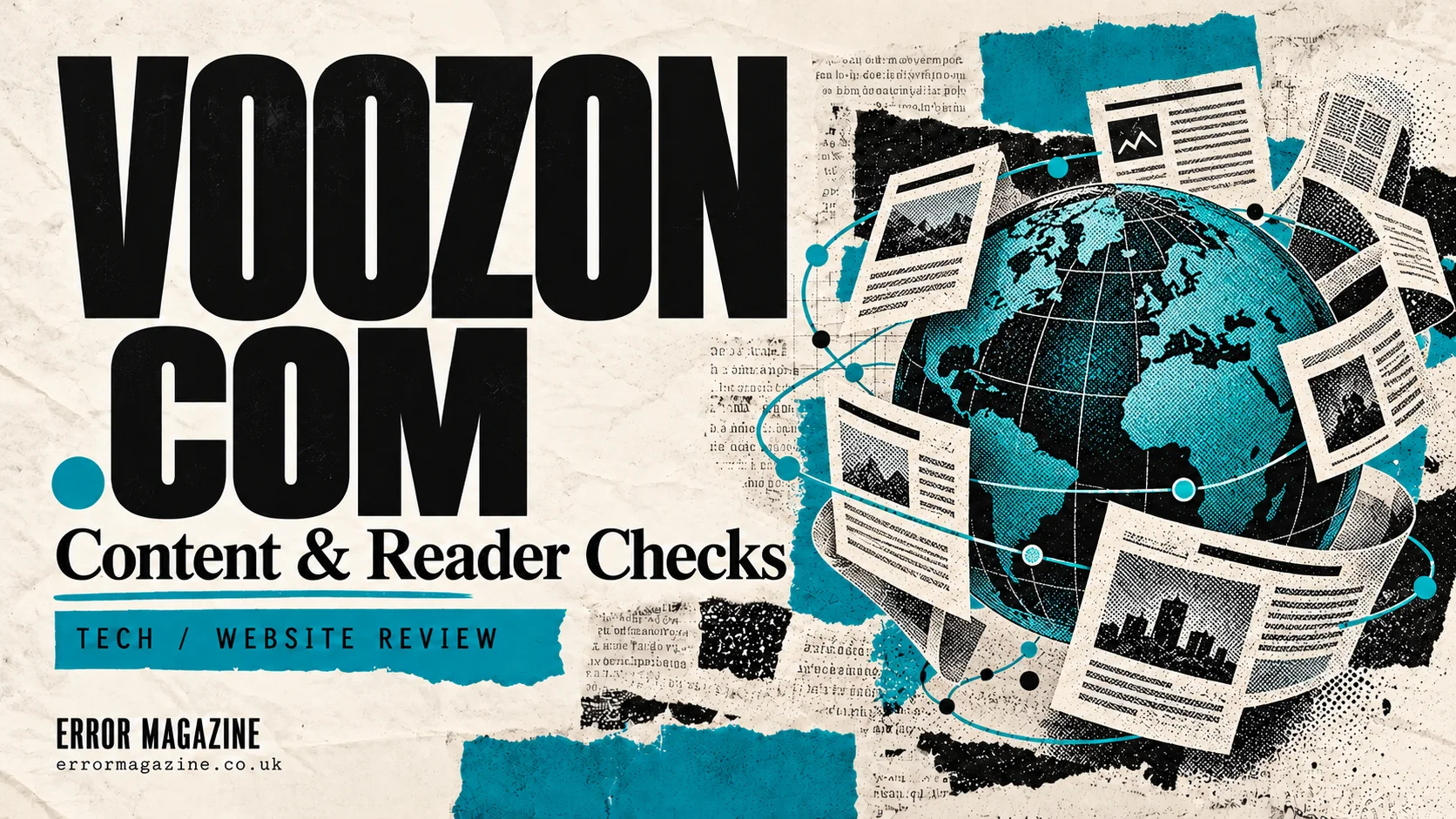

Voozon.com is a general-interest publishing website covering business, technology, finance, health, travel and other subjects. It also accepts outside contributions and promotes guest-posting opportunities.
Its public pages serve two audiences: people looking for information and contributors interested in publishing articles. Understanding both sides helps explain what the website offers—and how to assess its claims.
What Does Voozon.com Publish?
Voozon’s homepage contains articles across several categories. During research on 29 October 2026, visible subjects included wireless earbuds, data recovery software, employee break rooms, electric dirt bikes and studying abroad.
That mix makes it a broad online publication rather than a specialist resource. Readers can browse different interests within one website, although the depth and usefulness of individual articles need separate assessment.
The homepage also displays publication dates from different periods. For example, a featured earbuds headline refers to 2024, while other visible entries carry October 2026 dates.
This matters when researching products or services. A page can remain accessible long after the information it contains needs updating, so check the article’s date and the period its headline describes.
Why Does the Website Also Discuss Guest Posting?
Guest posting is part of Voozon’s stated publishing model. Its About page invites bloggers, businesses and digital marketers to contribute material.
However, the page contains two different emphases. An opening section strongly promotes guest publishing and backlinks, while a later section describes Voozon primarily as a digital publication accepting selected outside contributions.
These descriptions can coexist: a publication can serve readers while accepting contributed articles. Still, visitors should distinguish the website’s editorial content from its commercial publishing offers.
A useful comparison appears in our guide to WallPostMedia’s content and contributor model. It explains why readers should examine an article’s purpose, authorship and supporting evidence when outside contributions form part of a publication.
What Does Voozon’s Editorial Policy Say?
Voozon’s published editorial policy outlines expectations for original material, relevant sources and clear writing. It also says contributors should disclose meaningful relationships and avoid unsupported claims.
The policy allows the publication to edit or reject submissions. It states that articles should provide useful information rather than exist mainly to carry backlinks.
Importantly, these are the publisher’s stated standards. A policy explains how a website says it operates; establishing consistent enforcement would require examining a representative sample of published work.
Readers can make a practical check by comparing an article against those standards. Does it identify its sources? Does its headline accurately describe the content? Can important factual claims be traced to reliable evidence?
Can You Trust Voozon.com?
The accessible pages establish that Voozon.com operates as a publishing website. They do not establish that every article is accurate, every contributor has specialist expertise, or every commercial offer provides good value.
Trust depends partly on what you need from a page. A general introduction to a subject requires a different level of evidence from a claim that could influence an important decision.
When reading an unfamiliar article, consider four questions:
- Who wrote it? Look for relevant experience or review information.
- When was it published? Check whether the information could have changed.
- What supports its claims? Follow references to the original evidence.
- What is its purpose? Notice whether it explains, reports, recommends or promotes something.
Our Yonochomp guide to website evidence and reader checks provides another example of separating what researchers can confirm from what remains uncertain. The same distinction helps when evaluating any unfamiliar publication.
This review did not include a technical security audit. It therefore does not certify Voozon’s downloads, external links, data handling or payment arrangements.
What Should Contributors Confirm Before Submitting?
Contributors should obtain the current requirements directly from the publication. A general invitation to submit articles does not explain every condition attached to a particular placement.
Before preparing content or agreeing to a paid arrangement, ask about the accepted subject, editorial review, fees, disclosures and link treatment. Also confirm whether the publisher may revise or remove the article later.
If audience exposure is the goal, request evidence relevant to comparable articles. A website-wide traffic figure does not show how many people will read one specific contribution.
Voozon’s About page promotes possible visibility and SEO benefits. Its editorial policy, however, explicitly rules out guarantees involving rankings, indexing, traffic and other search outcomes. Contributors should treat those limits as part of their evaluation.
Who Owns or Runs the Website?
The pages examined did not establish a clearly verified legal owner or a fully documented editorial team. That limits what this review can say about the organisation behind the publication.
A brand description, contributor name or contact route serves a different purpose from proof of ownership. Businesses considering a commercial arrangement can ask for the contracting party’s identity and written terms.
For ordinary readers, authorship and sourcing are more immediately useful checks. An article should provide enough context to judge its important claims without relying entirely on the website’s branding.
How Should Readers Use Voozon.com?
Voozon.com offers a place to discover articles across several subjects. Its broad coverage can introduce unfamiliar topics and suggest questions for further research.
The most useful approach is to assess the page you are reading. Check its date, evidence and purpose, then consult the original source when a claim matters to your decision.
For contributors, the central question is whether the publication reaches a relevant audience under clear terms. Publication itself is an outcome; readership, enquiries and search visibility require separate evidence.
Read more :
Debra Bollman: The Stenographer Behind the Nigel Hayes Moment